Market Form Isn’t Trying to Predict the Future
Market Form Isn’t Trying to Predict the Future – It’s Trying to Give You Better Information
One of the most common criticisms of Market Form is this:
“Just because a horse was backed before doesn’t mean it will be backed again.”
Or…
“The conditions are different.”
“The trainer’s intentions have changed.”
“Maybe the market only shortened because another horse played up at the start.”
They’re all fair points.
But they also misunderstand what Market Form is designed to do.
Market Form Is Evidence, Not Certainty
Nobody can tell you with certainty what will happen in today’s betting market.
Not me.
Not the bookmakers.
Not the biggest syndicates in racing.
Market Form isn’t pretending otherwise.
Instead, it asks a much simpler question:
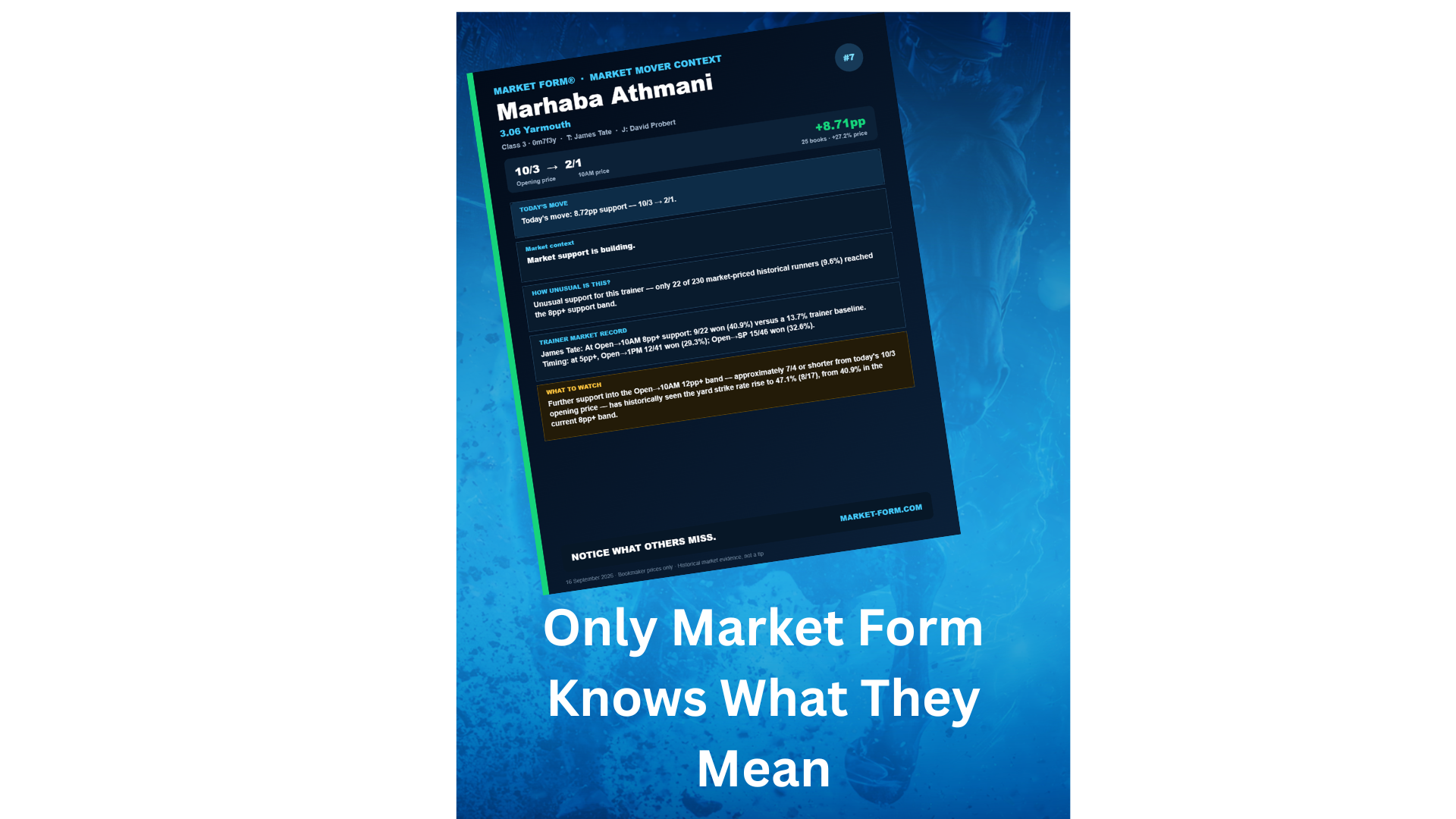
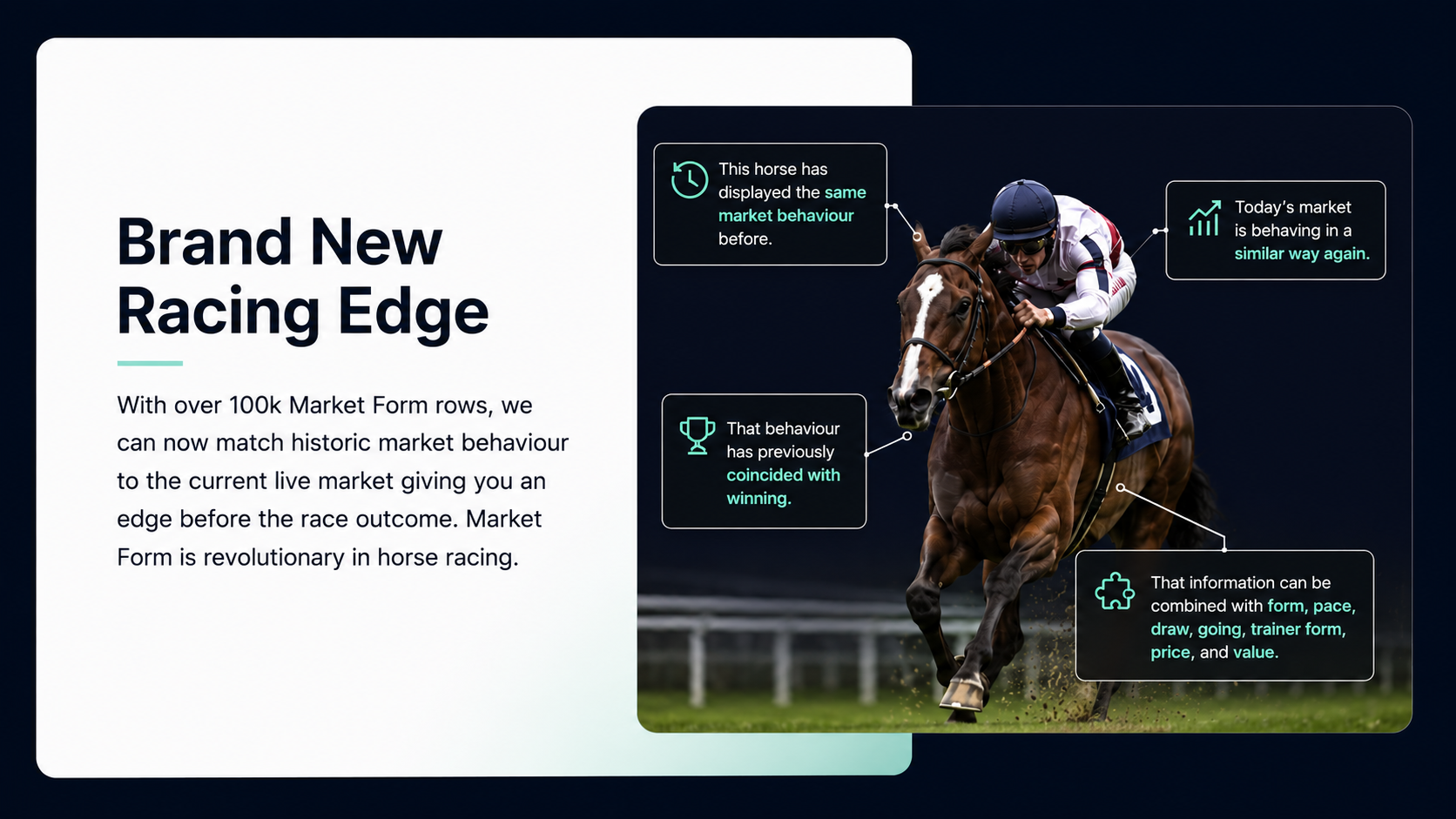
What has the market historically done when this horse has appeared under race conditions before?
That isn’t prediction.
It’s evidence.
There is a huge difference.
Every Piece of Racing Data Has Exceptions
If Market Form is dismissed because “things change”, then exactly the same criticism applies to almost every piece of racing information.
A trainer with a 28% strike-rate can lose.
A horse that loves soft ground can finish last.
A jockey with brilliant course statistics can have a terrible ride.
A horse dropping in class can still be beaten.
None of those statistics become worthless simply because they don’t work every time.
They’re probabilities.
Market Form is no different.
The Market Often Knows Something Before We Do
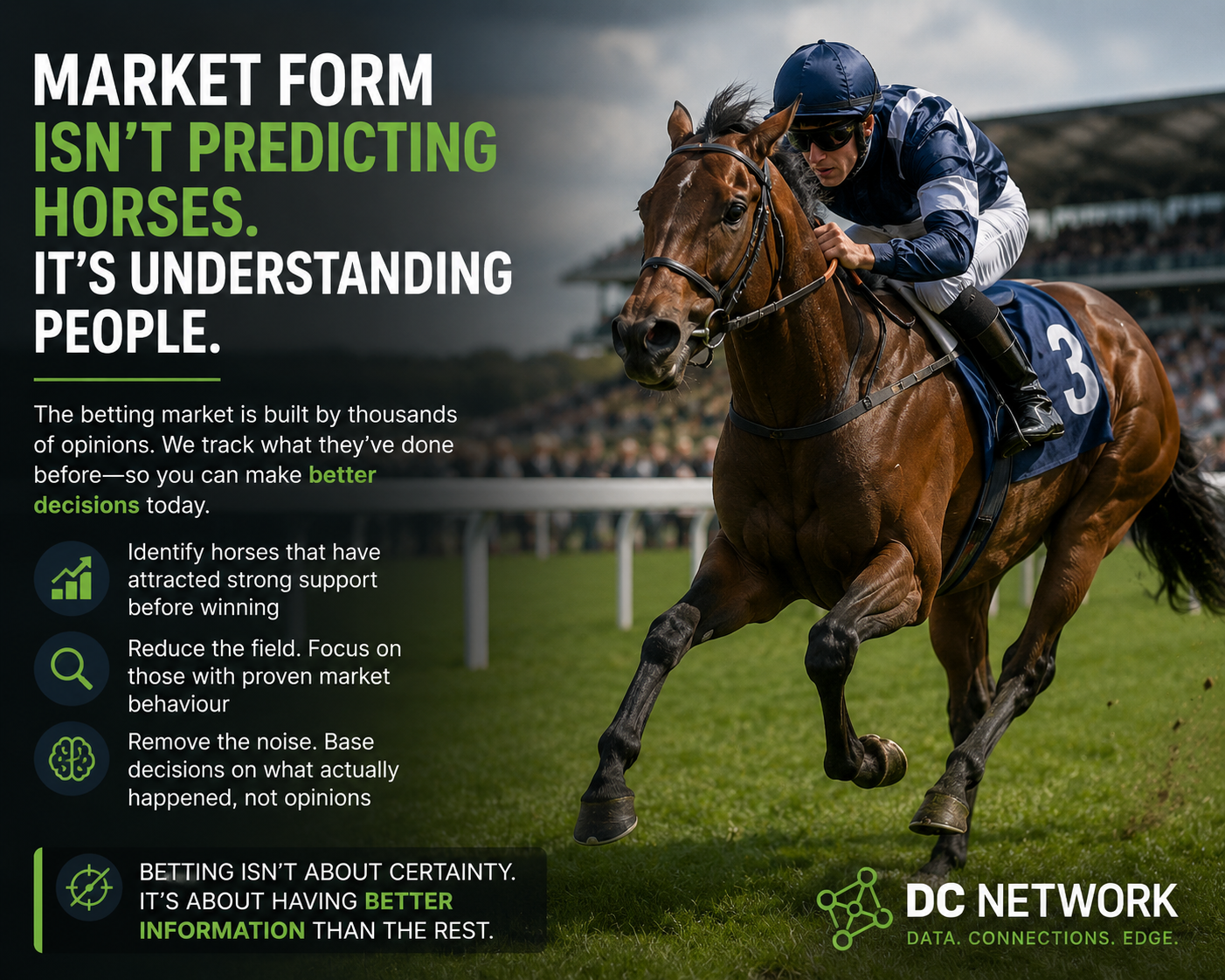
Betting markets are made up of thousands of opinions.
Owners.
Trainers.
Stable staff.
Professional gamblers.
Private ratings teams.
Bookmakers adjusting liabilities.
Information travels.
Money follows.
No single move tells the whole story.
But repeated market behaviour often tells us something about how connections tend to campaign a horse.
If a horse has shortened significantly before winning on three separate occasions, that is not proof it will happen again.
But it is certainly more informative than knowing nothing at all.
One Steam Means Very Little
This is another misunderstanding.
Market Form isn’t built around one random gamble.
One gamble could indeed happen because:
- another horse refused to load,
- the ground changed,
- a rival was withdrawn,
- somebody simply had a large bet.
That tells us almost nothing.
What becomes interesting is repetition.
When the same horse repeatedly attracts support before producing its best performances…
…again…
…and again…
…and again…
that is no longer a random event.
That is behaviour.
Behaviour is exactly what Market Form measures.
We Are Looking For Patterns, Not Stories
Racing is full of stories.
“This horse worked well.”
“The trainer likes this meeting.”
“The owner fancies it.”
Some are true.
Many are rumours.
Market Form removes the storytelling.
It simply asks:
What actually happened in the market?
Not what somebody said.
Not what somebody thought.
What happened.
Objective evidence is always stronger than opinion.
It Doesn’t Tell You What To Back
Perhaps the biggest misconception is that Market Form tells people what horse to bet.
It doesn’t.
It helps answer a different question:
Which horses deserve a closer look?
Imagine reducing a 14-runner handicap to four horses whose previous winning performances were all accompanied by strong market support.
You haven’t found the winner.
But you’ve dramatically reduced the amount of noise.
That alone is valuable.
Professional bettors spend years trying to eliminate horses.
Market Form helps do exactly that.
Information Creates Better Decisions
Suppose two horses have identical form.
Identical ratings.
Similar trainers.
Similar jockeys.
Horse A has repeatedly attracted strong support before its best runs.
Horse B has consistently drifted before disappointing.
Would you rather know that information…
…or not know it?
Even if it doesn’t change your selection every time, it changes the quality of your decision.
Good betting is about making better decisions, not finding certainty.
The Repeat Winner Principle
This is where Market Form becomes especially powerful.
One isolated market move proves very little.
Repeated market behaviour is different.
If a horse has shown the same betting profile before multiple winning performances, history tells us that behaviour is worth paying attention to.
Not because history must repeat.
But because repeated behaviour is rarely accidental.
Markets are created by people.
People repeat behaviours.
Connections repeat habits.
Professional punters repeat methods.
Patterns emerge.
Those patterns are exactly what Market Form records.
Nobody Should Bet Blindly
Market Form should never be used on its own.
It should sit alongside:
- race analysis,
- pace,
- ground,
- class,
- trainer form,
- draw,
- speed figures,
- your own judgement.
Think of it as another piece of the puzzle.
A valuable piece.
One that almost nobody else has available in this level of detail.
The Bottom Line
Will Market Form be right every time?
Of course not.
Nothing in racing is.
But dismissing it because exceptions exist misses the point entirely.
The real question isn’t:
“Does Market Form guarantee winners?”
The real question is:
“Does knowing how the market has behaved around this horse in the past help you make a more informed betting decision today?”
I believe the answer is unquestionably yes.
Because in betting, the goal isn’t certainty.
It’s making consistently better-informed decisions than the person standing next to you.
And information that most bettors never see is rarely information worth ignoring.