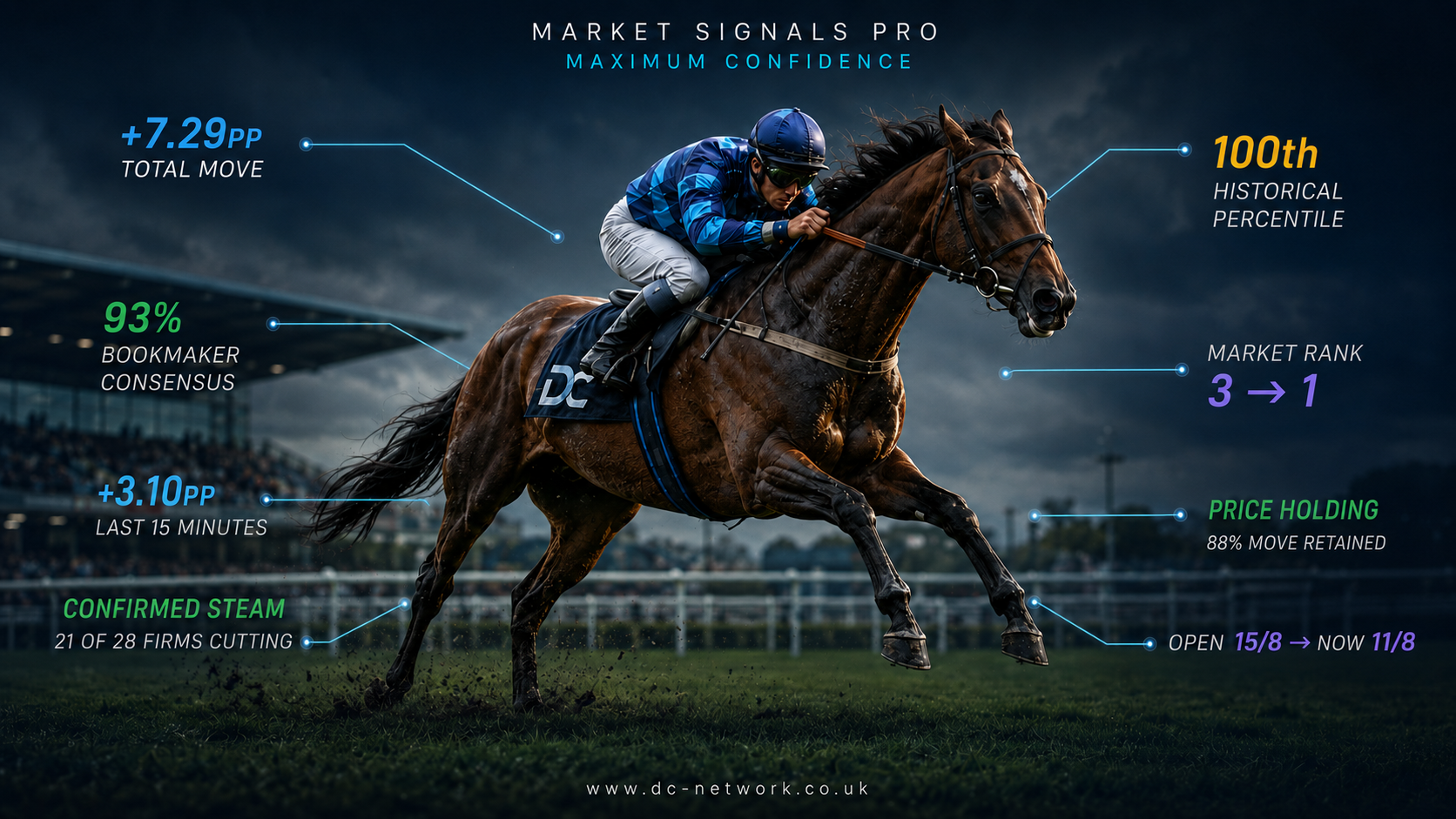

The “Favourite trap”
The Favourite Trap: Why Dismissing Short Prices Costs Bettors Money
Dismissing a runner simply because it sits at the top of the market ignores how modern betting markets actually function.
It is one of the most persistent adages in horse racing: “You’ll never win backing favourites.” Yet, even among seasoned punters, treating the market leader as a dirty word is a fundamental mistake.
“Favourite” is merely a label that reflects market consensus at a specific moment in time—it is a description of price, not a measure of intrinsic value.
Price vs. Probability: The True Definition of Value
Winning in betting boils down to a single principle: finding prices that are higher than a horse’s true probability of winning. Whether a selection is 1/2 or 20/1, value exists whenever:
Refusing to back a 2/1 shot that should logically be 5/4 means intentionally skipping profitable opportunities. A value winner at 2.50 pays money that spends exactly the same as a winner at 15.00—the only difference is whether the available odds justified the risk.
Market Form & The Favourite–Longshot Bias
Market data clearly demonstrates the reality of the Favourite–Longshot Bias. Punters tend to over-bet outsiders in pursuit of massive payouts, leaving favourites relatively under-bet by comparison.
| Price Bracket | Sample Win Rate | ROI at SP |
|---|---|---|
| Favourites | 34.2% | -10.49% |
| 20.0 – 39.99 Longshots | < 5.0% | -26.33% |
The pattern is unmistakable: blindly backing favourites will still lose money over time, but far less than blindly backing longshots. Returns deteriorate rapidly as the odds climb higher.
Psychology Over Mathematics
The main reason people say “I don’t back favourites” isn’t based on value or logic—it’s driven by psychological reward. A small return on short odds simply doesn’t offer the rush casual punters crave for their stake.
£10 @ 4/1 (Returns £50)
Preferred for the larger payout potential, even if the horse should actually be 6/1 (Negative Expected Value).
£10 @ 11/8 (Returns £23.75)
Often skipped due to low payout, even if the true price should be EVENS (Positive Expected Value).
Which Favourite Are You Opposing?
Because prices react constantly to incoming money, market positions are highly dynamic. So when someone claims they are “opposing the favourite,” which one are they actually avoiding?
- The opening price leader?
- The 10:00 AM market anchor?
- The horse backed heavily 10 minutes before the off?
- Or the official Starting Price (SP) favourite as the stalls open?
The only definitive favourite is the SP favourite. Until that moment, betting markets are fluid systems. Blanket rules against “favourites” break down instantly when exposed to shifting odds.
The Key Takeaway
If you enter a race determined to oppose the favourite, that view must have boundaries. There is always a price at which the favourite becomes genuine value—and a price at which the alternative no longer is. You are never simply betting for or against a horse; you are betting on whether the available odds accurately reflect its true chance of winning.