Why Market Form Matters
MARKET FORM® · THE CASE FOR CONTEXT
Why Market Form matters to every serious punter
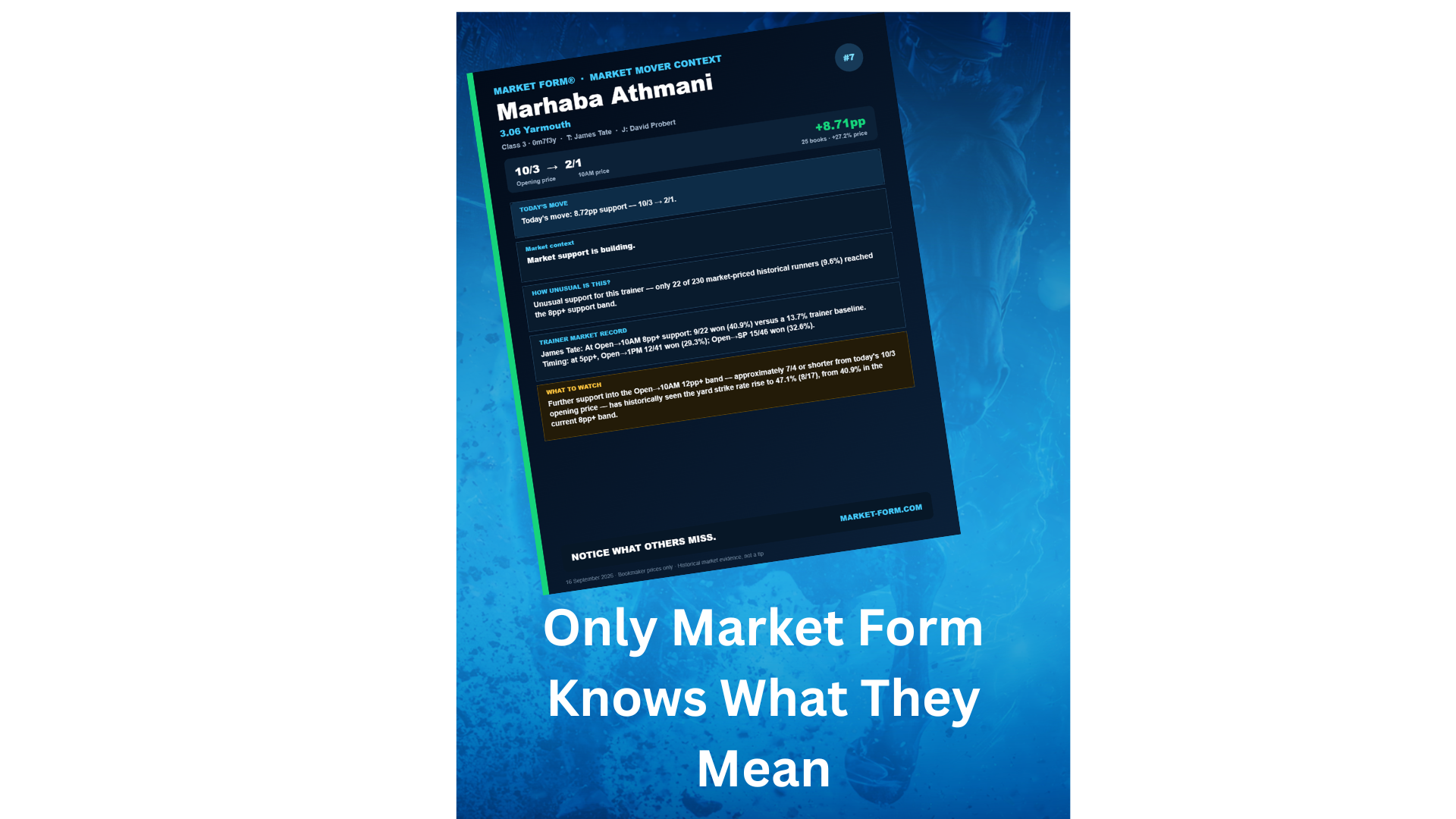
A horse shortens from 4/1 to 2/1. You can see the move. But do you know whether it means anything?
The price is the headline. The evidence behind it is the story. Market Form gives you the context to read that story before you decide whether to bet.
The same move can tell two different stories
Most racing screens can tell you that a price has fallen. That alone is not enough. A move may reflect genuine support, a thin market, a non-runner, or one bookmaker catching up with the rest. Two horses can shorten by the same amount for entirely different reasons.
Even when the backing is real, its significance depends on the horse and the people behind it. Is this yard frequently supported? Does it tend to win when its runners attract this sort of money? Is the move unusual for this particular horse? Are several bookmakers moving together, and has the support continued as the race approaches?
If you stop at “4/1 into 2/1”, you may be missing the most important part of the bet.
What Market Form puts around the price
Historical behaviour
See how comparable support or drift has played out for the horse, trainer and relevant market pattern. A move has more meaning when you can compare it with what happened before.
Trainer context
Compare a yard’s usual strike rate with its record under similar market conditions. Backing from one stable need not mean the same thing as backing from another.
Market depth and timing
Look beyond a single price: when did the move develop, how many bookmakers followed, and did it persist? A brief flicker and sustained support deserve different attention.
The true move
Non-runners can change the market without fresh confidence in a horse. Separating those adjustments from genuine support helps you judge what actually changed.
A drift is not automatically a warning
Punters often treat a shortening price as a positive and a drifting price as a negative. Racing is rarely that simple. A horse may drift because a rival has been heavily backed, because the market has widened, or because its early price was too short. Some yards and horses have performed well after drifting; others have not.
The useful question is not merely “Has it drifted?” It is “How has this horse or yard performed after a drift like this, in circumstances like these?” Market Form lets you investigate that distinction instead of reacting to the colour of an arrow.
Good information still needs the right price
Market context can tell you a runner deserves closer attention. It cannot make any price a good bet. A strong signal at 4/1 may offer a different decision from the same signal at 6/4. The available odds, the opposition and your own assessment still matter.
That is why Market Form is built to inform a decision, not replace one. It can help you spot a meaningful move, question a misleading one, leave a short-priced runner alone, or revisit a drifter the market may have overlooked.
THE EDGE IS IN THE CONTEXT
Stop seeing only the move. Start understanding it.
Every punter can see the latest odds. The advantage comes from asking better questions about why those odds changed and what similar moves have meant before. That is why Market Form belongs alongside the form book, the racecard and your price assessment.
It will not tell you that a horse must win. It will help you see what other punters may miss.