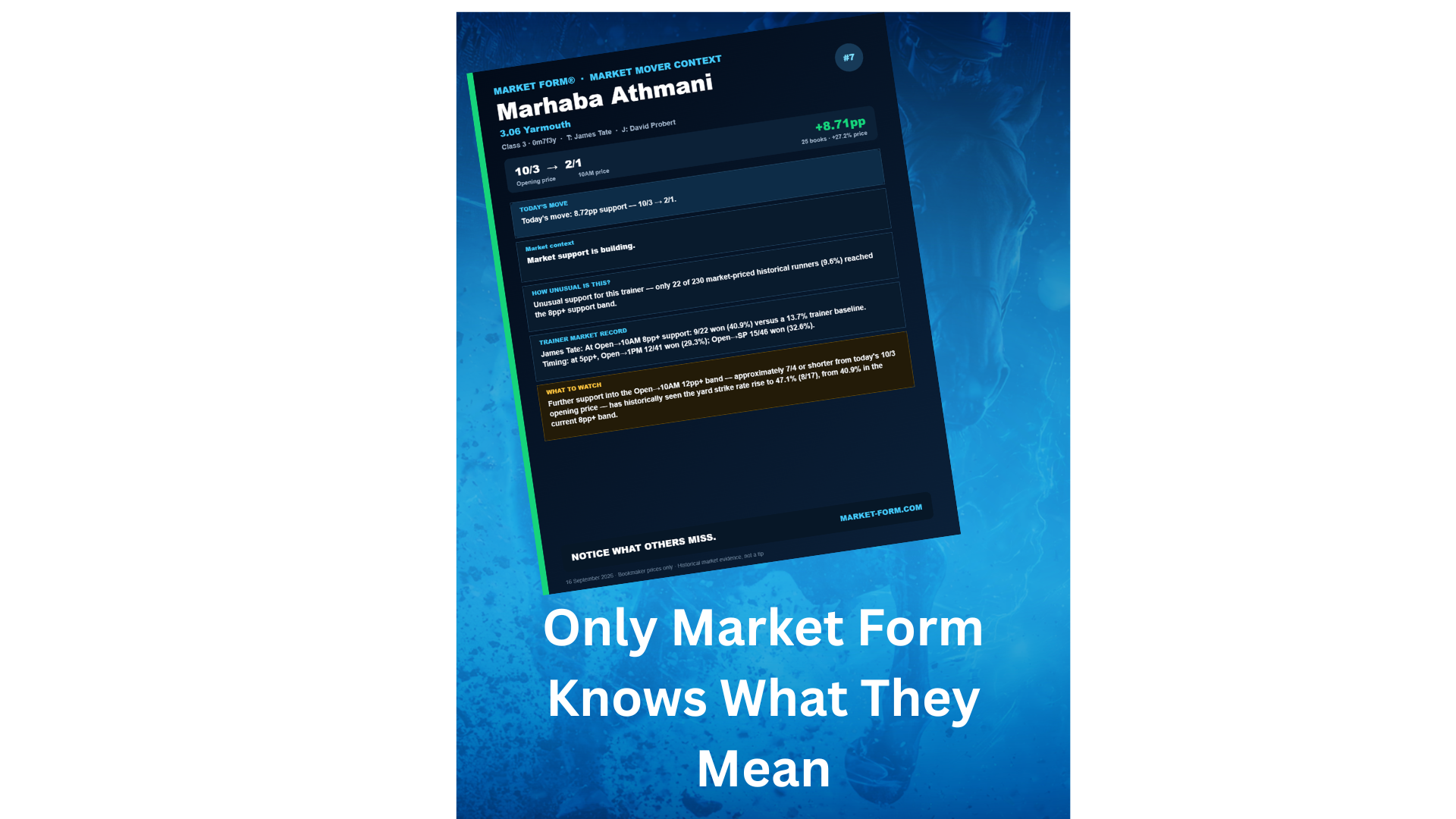

Repeat Winner Model Logic and Forward testing
One of the most common questions I’ve received since launching the Repeat Winner Signals™ project is:
“If the historical testing showed an ROI of over 80%, why aren’t the live results showing the same figures?”
It’s a fair question, and it’s important to understand exactly what the system is doing.
Two Different Measurements
When discussing Repeat Winner Signals, there are really two separate figures.
Historical Model Performance
The first figure comes from the historical research.
This is where the Market Form database studies thousands of previous races and asks a simple question:
When a horse repeats the same market behaviour that accompanied previous successful runs, what tends to happen next?
The purpose of this research is not to create a betting record. Its purpose is to establish whether repeatable market behaviour actually exists and whether it has predictive value.
Without this stage, there is no foundation for the project.
Think of this as the laboratory.
The model is examining thousands of historical examples, identifying patterns and determining which behaviours appear to be worth following.
Walk-Forward Performance
The second figure is what most punters are really interested in.
What would have happened if I backed every qualifying Repeat Winner Signal using only information available at the time?
To answer that question, I recently ran a walk-forward style test using only information known before each race was run.
The criteria – trade secrets:
- Minimum of two previous qualifying examples
- No future information
- Settled at SP
- Every qualifier included
Since inception the Repeat Winner Signals results were:
- 198 Bets
- 62 Winners
- 93 Placed
- +28.83 Points Profit
- 14.56% ROI
This is a far tougher test than the historical research because the model cannot look into the future. Every horse either wins or loses based solely on information that existed before the race was run.
Is The Model Rewriting History?
No.
This is probably the biggest misconception.
The model is not going back through history and changing selections to make itself look better.
Instead, it is attempting to identify which repeat behaviours appear to be strongest and which appear to be weakest.
As more races are added to Market Form, the database grows, sample sizes improve and the system gains a better understanding of what has genuine predictive value.
The objective isn’t to improve past results.
The objective is to improve future decisions.
What Is The Learning Engine Actually Trying To Do?
The historical research provides a target.
The walk-forward results show where we are today.
The learning engine is the process that attempts to bridge the gap between the two.
Nobody should realistically expect a developing model to produce an 80% ROI from day one in live conditions.
However, if historical testing identifies certain market behaviours as particularly effective, then those are exactly the behaviours we want the model to prioritise moving forward.
In practical terms, I don’t expect the future to involve:
- More signals
- More bets
- More noise
I expect the future to involve:
- Better signal selection
- Stronger filtering
- Larger sample sizes
- More confidence in proven behaviours
- Removal of weaker patterns
The goal is not quantity.
The goal is quality.
Where Does This Go Next?
The exciting part is that Market Form grows every single day.
Every race creates more information.
Every market move creates more information.
Every winner and loser teaches the system something new.
Over time, the database becomes richer and the learning engine becomes more selective.
That doesn’t guarantee future performance will ever match the best historical figures.
No honest researcher can promise that.
What it does mean is that the system is continually working towards identifying the strongest repeat market behaviours and improving the quality of future qualifiers with the historical results (80%ROI) or closest to, the ultimate aim.
The Takeaway
For me, the most encouraging finding is not the historical ROI.
It’s the fact that when we strip away hindsight and test the concept using only information available at the time, the edge remains profitable.
The historical research tells us there is something worth investigating.
The walk-forward results suggest there is something worth following.
The learning engine exists to continually improve the connection between those two things.
And that’s exactly what Repeat Winner Signals™ is designed to do.
I ran the exact same forward-style test across different levels of repeat behaviour using only information that would have been known before each race.
🟡 Emerging Pattern (1 previous qualifying run)
- Bets: 1,119
- Winners: 277
- Placed: 462
- Profit: -85.14 pts SP
- ROI: -7.61%
🟢 Repeat Winner Signal (2 previous qualifying runs)
- Bets: 198
- Winners: 62
- Placed: 93
- Profit: +28.83 pts SP
- ROI: +14.56%
⭐ Elite Repeat Winner Signal (3 previous qualifying runs)
- Bets: 37
- Winners: 17
- Placed: 24
- Profit: +18.63 pts SP
- ROI: +50.35%
What this tells us is something very important.
A horse showing the behaviour once before is not enough. The Emerging Pattern group actually loses money overall. However, once a horse has demonstrated the same market behaviour multiple times, the edge improves dramatically.
The progression is striking:
1 previous run = -7.61% ROI
2 previous runs = +14.56% ROI
3 previous runs = +50.35% ROI
This is exactly what we would hope to see if the underlying concept is genuine. The more evidence we have that a horse repeatedly responds to market support, the stronger the historical edge becomes.
This is also why the learning model focuses on identifying repeatable behaviour rather than isolated examples. One occurrence can be luck. Multiple occurrences suggest a genuine market pattern.
The Elite figures are particularly interesting because they are derived from a relatively small, highly selective sample of horses with established repeat market behaviour.