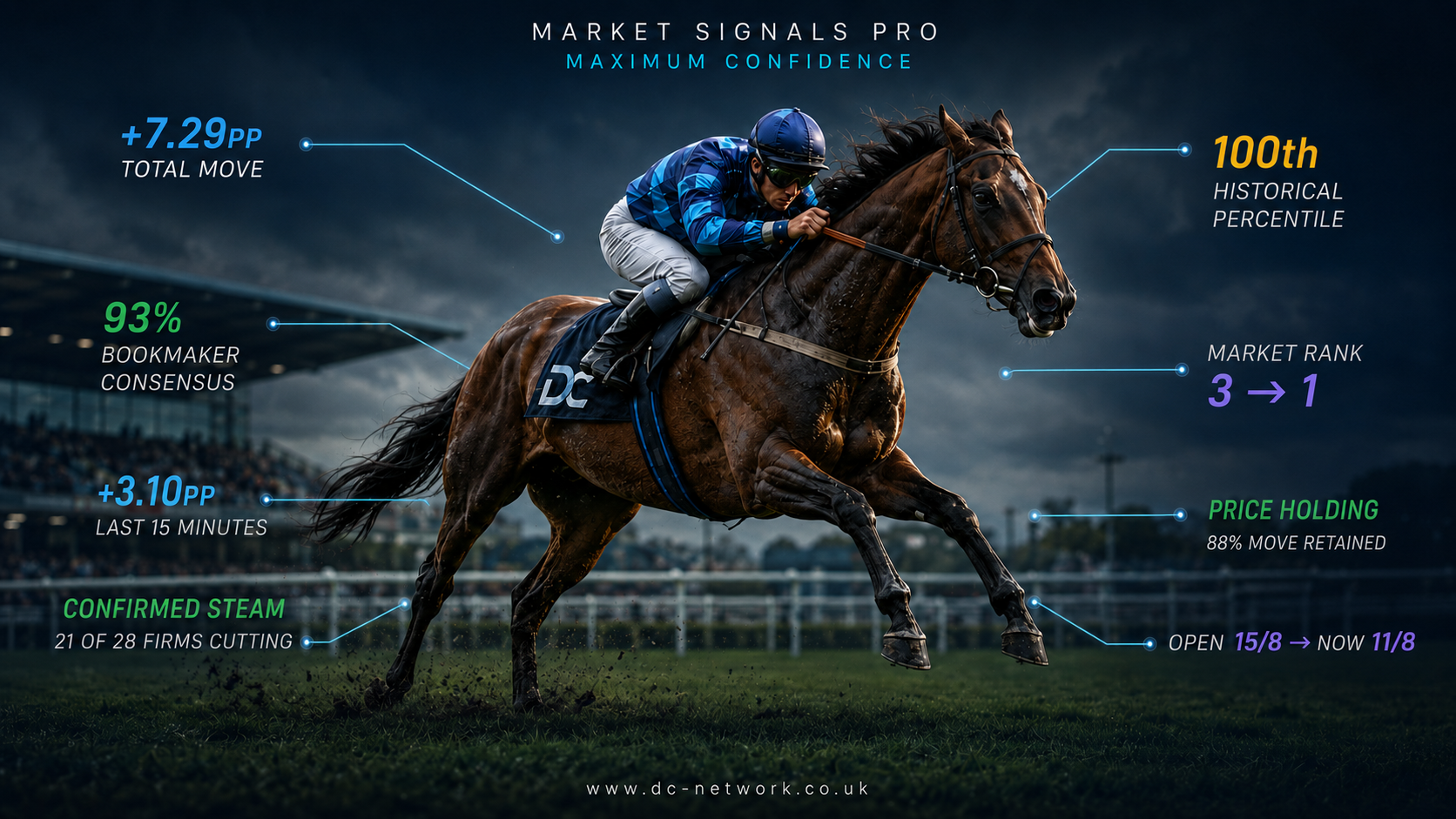

Tomorrow’s Racing Briefing: What to Watch on Sunday 27 September
Good evening. The declarations are in and DC Network has completed its first serious read of the card for Sunday 27 September 2026. This is your chance to understand tomorrow’s interesting market conditions before the noise of raceday begins.
This is not a list of tips dressed up as analysis. It is a forward-looking briefing built from each runner’s previous fixed-odds Market Form. The aim is to know what deserves attention tomorrow, what evidence would strengthen the case and—just as importantly—what would tell us to walk away.
Tonight’s overall read
The card contains 19 historically constructive profiles and 10 warning profiles. There are worthwhile possibilities, but the price action still has to confirm them. Early support from one firm is not enough; the stronger clues will be moves that spread and hold.
The strongest historical condition tonight belongs to Galileo Dame in the 4:20 Curragh. Its label is Support Has Been Significant. That makes it a horse to monitor—not an automatic bet.
Tomorrow’s opportunities
This is where the pre-market evidence is strongest. These runners are ranked because their own histories show meaningful support and the surrounding evidence helps identify whether tonight’s price may be worth monitoring before the wider market develops. They remain opportunities to investigate, not blind selections: the stated confirmation still needs to appear.
Rhodes Runner
Rhodes Runner has attracted meaningful support in 4 of 8 recorded markets (50.0%), with an average move of 12.7 probability points.
Outcome evidence: 0 wins and 3/4 placed when supported.
Price timing: On 1 of 4 supported runs with complete snapshots, the 10am price was bigger than both the 1pm price and SP.
Class context: 1 of 2 comparable class-change runs were supported (50.0%).
Stable activity: Higher support than usual. The yard has supported 31.1% of its recent runners (28/90), compared with 24.0% normally.
What confirms it: Support reaching 10 probability points would place this runner back inside a historically productive market range. Give the move more weight if it is broad, sustained and still present near the off.
Dismiss it if: The threshold is never reached, or early support fades and is replaced by sustained weakness.
Call Time
Call Time has attracted meaningful support in 4 of 6 recorded markets (66.7%), with an average move of 10.0 probability points.
Outcome evidence: 1 win and 2/4 placed when supported.
Price timing: On 2 of 4 supported runs with complete snapshots, the 10am price was bigger than both the 1pm price and SP.
Class context: 4 of 5 comparable class-change runs were supported (80.0%).
Stable activity: 30-day trainer support. The yard has supported 20.0% of its recent runners (2/10), compared with 20.0% normally.
What confirms it: Support reaching 6 probability points would place this runner back inside a historically productive market range. Give the move more weight if it is broad, sustained and still present near the off.
Dismiss it if: The threshold is never reached, or early support fades and is replaced by sustained weakness.
Flash Man
Flash Man has attracted meaningful support in 3 of 5 recorded markets (60.0%), with an average move of 10.2 probability points.
Outcome evidence: 1 win and 3/3 placed when supported.
Price timing: On 1 of 3 supported runs with complete snapshots, the 10am price was bigger than both the 1pm price and SP.
Class context: 2 of 3 comparable class-change runs were supported (66.7%).
Stable activity: Insufficient recent evidence. The recent yard sample is only 0 runners, so its longer-term 28.1% support rate is more informative.
What confirms it: Support reaching 6 probability points would place this runner back inside a historically productive market range. Give the move more weight if it is broad, sustained and still present near the off.
Dismiss it if: The threshold is never reached, or early support fades and is replaced by sustained weakness.
Rosemary's Rose
Rosemary's Rose has attracted meaningful support in 6 of 12 recorded markets (50.0%), with an average move of 9.5 probability points.
Outcome evidence: 1 win and 4/6 placed when supported.
Price timing: On 3 of 6 supported runs with complete snapshots, the 10am price was bigger than both the 1pm price and SP.
Class context: 5 of 9 comparable class-change runs were supported (55.6%).
Stable activity: Quieter support than usual. The yard has supported 14.0% of its recent runners (7/50), compared with 23.9% normally.
What confirms it: Support reaching 6 probability points would place this runner back inside a historically productive market range. Give the move more weight if it is broad, sustained and still present near the off.
Dismiss it if: The threshold is never reached, or early support fades and is replaced by sustained weakness.
Desiderata
Desiderata has attracted meaningful support in 5 of 10 recorded markets (50.0%), with an average move of 9.6 probability points.
Outcome evidence: 1 win and 3/5 placed when supported.
Price timing: On 5 of 5 supported runs with complete snapshots, the 10am price was bigger than both the 1pm price and SP.
Class context: 4 of 9 comparable class-change runs were supported (44.4%).
Stable activity: Insufficient recent evidence. The recent yard sample is only 5 runners, so its longer-term 21.1% support rate is more informative.
What confirms it: Support reaching 4 probability points would place this runner back inside a historically productive market range. Give the move more weight if it is broad, sustained and still present near the off.
Dismiss it if: The threshold is never reached, or early support fades and is replaced by sustained weakness.
The races to put on your radar
4:20 Curragh
5 runners in this race carries a serious historical market condition. Read them together: competing signals within one race can be more informative than a single horse viewed in isolation.
Galileo Dame — trained by Joseph Patrick O'Brien · Support Has Been Significant
When supported by at least 10 probability points, this horse made the first three on 3 of 3 occasions (100.0%), including 1 win.
Tomorrow’s tell: Support reaching 10 probability points would place this runner back inside a historically productive market range. Give the move more weight if it is broad, sustained and still present near the off.
Dismiss it if: The threshold is never reached, or early support fades and is replaced by sustained weakness.
Too Bossy For Us — trained by W. P. Mullins · Drift Has Been a Material Negative
When drifting by at least 4 probability points, this horse failed to make the first three on 3 of 3 occasions (100.0% failure rate).
Tomorrow’s tell: A sustained drift reaching 4 probability points would recreate a market condition that has previously coincided with underperformance. Treat broad weakness as a material warning.
Dismiss it if: The drift reverses decisively and is replaced by broad, sustained support.
Holy See — trained by William Durkan · Capable Despite Market Weakness
Despite drifting by at least 6 probability points, this horse still made the first three on 2 of 3 occasions (66.7%), including 1 win.
Tomorrow’s tell: If weakness reaches 6 probability points, treat it as context rather than an automatic rejection. The key question is whether the drift stabilises while the horse’s wider form case remains intact.
Dismiss it if: Weakness accelerates beyond the historical range or continues across the market without stabilising.
4:44 Ffos Las
4 runners in this race carries a serious historical market condition. Read them together: competing signals within one race can be more informative than a single horse viewed in isolation.
Benavente — trained by Gary Brown · Drift Has Been a Material Negative
When drifting by at least 6 probability points, this horse failed to make the first three on 4 of 4 occasions (100.0% failure rate).
Tomorrow’s tell: A sustained drift reaching 6 probability points would recreate a market condition that has previously coincided with underperformance. Treat broad weakness as a material warning.
Dismiss it if: The drift reverses decisively and is replaced by broad, sustained support.
Arvana Belle — trained by Rod Millman · Drift Has Been a Material Negative
When drifting by at least 4 probability points, this horse failed to make the first three on 3 of 3 occasions (100.0% failure rate).
Tomorrow’s tell: A sustained drift reaching 4 probability points would recreate a market condition that has previously coincided with underperformance. Treat broad weakness as a material warning.
Dismiss it if: The drift reverses decisively and is replaced by broad, sustained support.
Desiderata — trained by Thomas Faulkner · Support Has Been Significant
When supported by at least 4 probability points, this horse made the first three on 3 of 5 occasions (60.0%), including 1 win.
Tomorrow’s tell: Support reaching 4 probability points would place this runner back inside a historically productive market range. Give the move more weight if it is broad, sustained and still present near the off.
Dismiss it if: The threshold is never reached, or early support fades and is replaced by sustained weakness.
3:22 Epsom
3 runners in this race carries a serious historical market condition. Read them together: competing signals within one race can be more informative than a single horse viewed in isolation.
Oasis Sunrise — trained by Grace Harris · Capable Despite Market Weakness
Despite drifting by at least 4 probability points, this horse still made the first three on 5 of 6 occasions (83.3%), including 2 wins.
Tomorrow’s tell: If weakness reaches 4 probability points, treat it as context rather than an automatic rejection. The key question is whether the drift stabilises while the horse’s wider form case remains intact.
Dismiss it if: Weakness accelerates beyond the historical range or continues across the market without stabilising.
Taritino — trained by Joe Tickle · Support Has Been Significant
When supported by at least 4 probability points, this horse made the first three on 4 of 4 occasions (100.0%), including 2 wins.
Tomorrow’s tell: Support reaching 4 probability points would place this runner back inside a historically productive market range. Give the move more weight if it is broad, sustained and still present near the off.
Dismiss it if: The threshold is never reached, or early support fades and is replaced by sustained weakness.
Flash Man — trained by Toby Lawes · Support Has Been Significant
When supported by at least 6 probability points, this horse made the first three on 3 of 3 occasions (100.0%), including 1 win.
Tomorrow’s tell: Support reaching 6 probability points would place this runner back inside a historically productive market range. Give the move more weight if it is broad, sustained and still present near the off.
Dismiss it if: The threshold is never reached, or early support fades and is replaced by sustained weakness.
4:09 Ffos Las
3 runners in this race carries a serious historical market condition. Read them together: competing signals within one race can be more informative than a single horse viewed in isolation.
Rosemary's Rose — trained by Rod Millman · Support Has Been Significant
When supported by at least 6 probability points, this horse made the first three on 4 of 5 occasions (80.0%), including 1 win.
Tomorrow’s tell: Support reaching 6 probability points would place this runner back inside a historically productive market range. Give the move more weight if it is broad, sustained and still present near the off.
Dismiss it if: The threshold is never reached, or early support fades and is replaced by sustained weakness.
Pebble Dash — trained by Bernard Llewellyn · Drift Has Been a Material Negative
When drifting by at least 4 probability points, this horse failed to make the first three on 3 of 3 occasions (100.0% failure rate).
Tomorrow’s tell: A sustained drift reaching 4 probability points would recreate a market condition that has previously coincided with underperformance. Treat broad weakness as a material warning.
Dismiss it if: The drift reverses decisively and is replaced by broad, sustained support.
Prince Ali — trained by Thomas Faulkner · Capable Despite Market Weakness
Despite drifting by at least 4 probability points, this horse still made the first three on 3 of 4 occasions (75.0%), including 1 win.
Tomorrow’s tell: If weakness reaches 4 probability points, treat it as context rather than an automatic rejection. The key question is whether the drift stabilises while the horse’s wider form case remains intact.
Dismiss it if: Weakness accelerates beyond the historical range or continues across the market without stabilising.
2:24 Ffos Las
2 runners in this race carries a serious historical market condition. Read them together: competing signals within one race can be more informative than a single horse viewed in isolation.
Some Nightmare — trained by John O'Shea · Capable Despite Market Weakness
Despite drifting by at least 10 probability points, this horse still made the first three on 2 of 3 occasions (66.7%).
Tomorrow’s tell: If weakness reaches 10 probability points, treat it as context rather than an automatic rejection. The key question is whether the drift stabilises while the horse’s wider form case remains intact.
Dismiss it if: Weakness accelerates beyond the historical range or continues across the market without stabilising.
Call Time — trained by J. S. Moore · Support Has Been Significant
When supported by at least 6 probability points, this horse made the first three on 2 of 3 occasions (66.7%), including 1 win.
Tomorrow’s tell: Support reaching 6 probability points would place this runner back inside a historically productive market range. Give the move more weight if it is broad, sustained and still present near the off.
Dismiss it if: The threshold is never reached, or early support fades and is replaced by sustained weakness.
What smart punters should look for tomorrow
- Width before speed. A rapid cut from one bookmaker can be noise. A steadier move involving several firms is normally more meaningful.
- Persistence near the off. The best confirmation is a move that remains visible as liquidity and attention build. Support that disappears has failed an important test.
- Read the whole race. A horse shortening while its principal rivals also strengthen tells a different story from a clear, isolated move.
- Respect invalidation. Every angle above includes a reason to dismiss it. Acting on that evidence is discipline, not a missed opportunity.
A sensible plan for the morning
Start by checking for non-runners and meaningful going changes, then revisit the races above. Note the opening shape of each market rather than reacting to a single headline price. As the day develops, compare live movement with tonight’s stated confirmation and invalidation conditions. If the expected behaviour never arrives, leave the historical pattern in the notebook.
Follow tomorrow’s market as it develops
The full watchlist contains every qualifying profile. The live terminal lets you test tonight’s historical conditions against tomorrow’s bookmaker movement.
Generated from DC Network’s historical fixed-odds Market Form and declared racecards. This briefing provides contextual information, not guarantees or betting recommendations. Racecards and conditions can change.