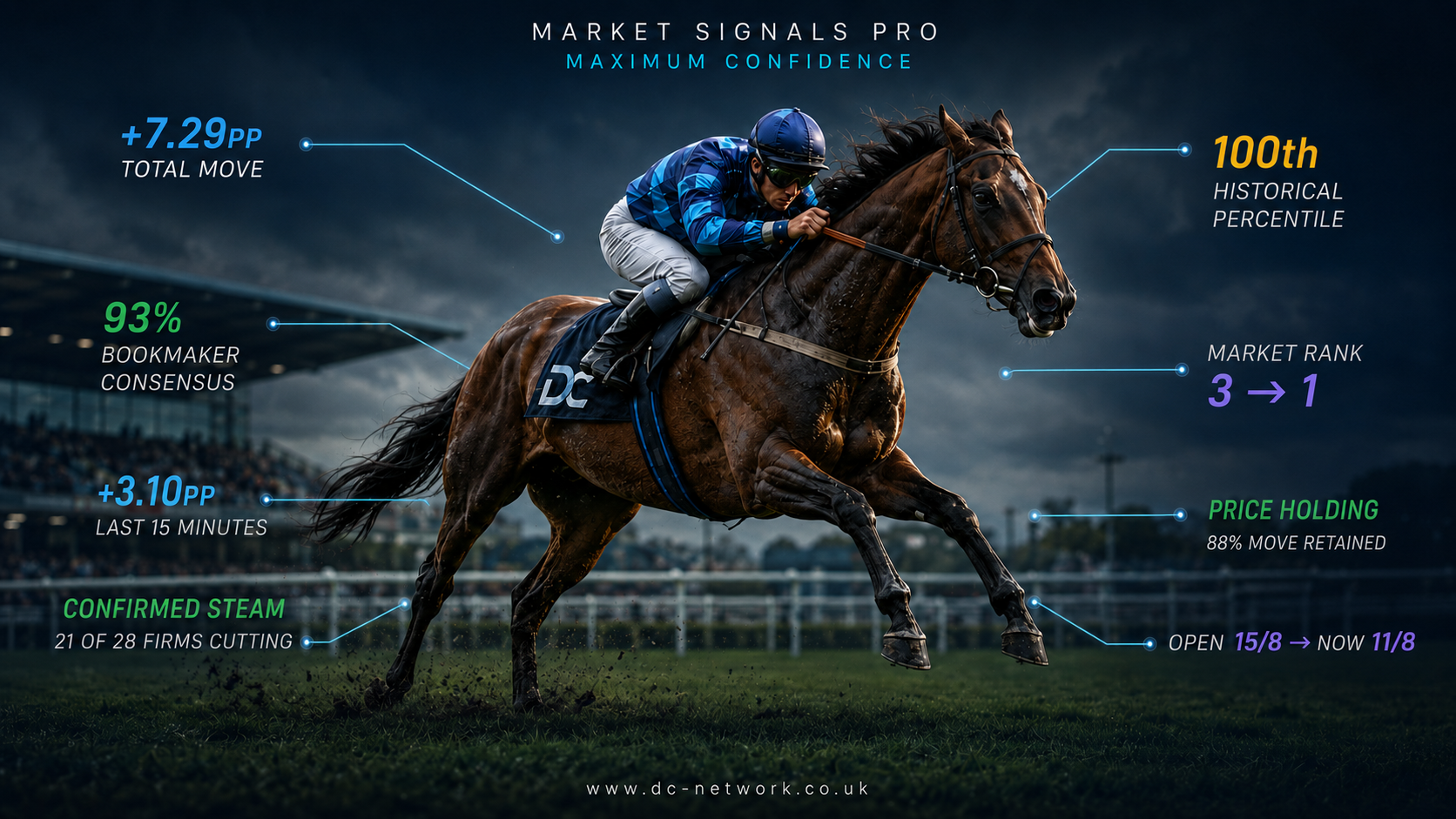

DC Market Intelligence Report –Oct 2, 2026
What the market knew, what the results proved, and what the evidence means for today.
Yesterday’s Market Scorecard
Underperformed expectation
01 The Market Verdict
Yesterday’s strong-steamer set (93 qualifiers, defined as a 10am→final contraction of at least 15%) produced 12 winners from 44 races on the day. That raw strike rate (12.9%) reads serviceable in isolation, but the more important test is whether the late money beat the closing market’s own expectations. On that measure it did not: 12 wins versus 13.59 expected at final implied prices delivered a performance index of 88.3, meaning the steamers underperformed what the market itself priced in by the off.
The price-action profile matters here. The average Open→10am move was slightly negative (-0.75pp), while the average 10am→final move was strongly positive in implied probability terms (+4.01pp). In plain English: much of the “information” arrived late and was sizeable. The problem is that, despite that late conviction, results still landed below expectation. This is a key distinction: the day didn’t just miss at big early prices; it failed to convert the advantage implied by the final prices.
Zooming out, that single-day underperformance is aligned with the broader rolling context rather than being a one-off wobble. Over the last 30 days (2,383 qualifiers), the performance index sits at 80.4 (317 wins vs 394.40 expected). That is a sustained pattern of late-backed runners failing to match the closing market’s theoretical win count. Yesterday’s 88.3 is less severe than the 30-day backdrop, but it is still on the same side of the line.
The P/L figures underline the same structural message without turning this into a tips ledger: strong steamers were positive at 10am prices (+26.50 pts) but far less so by SP (+5.66 pts). In the 30-day sample, that gap is extreme: +432.66 pts at 10am, but -430.23 pts at SP. The consistent theme is value compression: whatever edge existed earlier is repeatedly priced away by the time the market fully forms, and the realised outcomes have not been keeping pace with the late contraction signal.
02 Market Beaters vs Money That Misfired
Market beaters
- Tullyveery Lad (19.00→10.00) converted a meaningful late contraction and still returned at an SP (15.00) that shows not all platforms aligned; the win indicates the move wasn’t merely price-chasing.
- Sister Nancy (6.00→3.25) was the archetype of a strong steamer that the market pushed towards the front end; the win validates the late push even though the SP (3.00) suggests continued support into the off.
- Dalamara (7.50→4.50) and Autocrat (4.50→3.50) both did what the closing market said they were increasingly likely to do: win. These are the “cleanest” confirmations of late money being directionally right.
- Magnum Cor (2.00→1.57) is important because short-priced steamers carry high implied expectation; landing them matters disproportionately to performance index stability.
- Due To Henry (36.00→29.00) is a reminder that some contractions are still relatively small in probability terms (0.67pp here), yet they can still be informative when the move is genuine and sustained.
Money that misfired
- Volez Vous (23.00→9.00) is the headline “false steamer” by magnitude, and finishing 7th is exactly the kind of miss that drags confidence in the signal when the contraction is severe.
- Mayflyer (15.00→6.50) also attracted heavy late support but finished 7th; this is another example of the market forcing a horse into a much higher-probability bracket than the outcome justified.
- Stytch (21.00→9.50) and Kingdom Of Kush (11.00→5.50) show the same pattern: big compressions that did not translate into competitiveness on the day (8th and 6th).
- Dropping Dimes (26.00→11.00) finished 3rd; that is not “dead money” in information terms. The move did locate performance, but not the win required to match the market’s upgraded probability.
- Star Rose (8.00→4.00) also ran 3rd; again, the steamer found ability but stopped short of paying back the implied jump in win chance.
- Mr Freedom (13.00→7.00) finishing 4th is a similar near-miss: the market push looked justified in competitiveness, but not enough to clear the bar set by the close.
03 Where the Money Went
Repeated connections
Repeated trainer/jockey appearances are best treated as a map of where money clustered, not as proof of a stable edge from a single day’s returns. That said, yesterday’s distribution shows a clear concentration of support that did not consistently cash.
- Trainer support that drew volume but did not convert yesterday: John McConnell (3 backed / 0 won), plus several two-backed yards going 0-from-2 (P J Rothwell, Tony Carroll, Hugo Palmer, Ms Claire O’Connell, Gordon Elliott, James Fanshawe).
- Trainer support that did convert at least once: Eve Johnson Houghton (2/1), Craig Lidster (2/1), Katie Scott (2/1), with single backed-and-won runners for R P Cody (1/1) and Daniel McLoughlin (1/1).
- Jockey clustering without wins: David Egan (3/0), Alan O’Sullivan (3/0), Siobhan Rutledge (3/0), alongside multiple 0-from-2s (Rory Cleary, Alex Harvey, Silvestre De Sousa, Philip Byrnes, Daniel Muscutt).
- Jockeys with at least one conversion from repeated support: Rowan Scott (2/1), Callum Hutchinson (2/1), J M Sheridan (2/1), Jason Hart (2/1).
The key read is not that any one trainer or rider is “cold”; it’s that heavy clustering of late money can still be wrong on the day, reinforcing the need to treat steam as information to be validated, not as an outcome guarantee.
The other side of the market
The late drifters list provides a useful counterpoint: horses the market actively de-selected into the off, often while still running with some credit. Several of these drifted materially in probability terms and still hit the frame, suggesting the market’s late caution was not always a total performance fade.
- Abbotsford (2.1→3) finished 2nd: a meaningful late drift that did not equate to non-competitiveness.
- Cromane (2.1→2.75) finished 2nd: another instance where the drift signalled reduced win confidence, but not a collapse.
- St Lawrence’s Well (3.25→5) finished 3rd: the market cooled late, yet the run still broadly aligned with “place-level” ability.
- Sharper drifts that were more decisively negative: Migdam (6→21) finished 7th and Vaureal (4→6) finished 11th, closer to the classic “market says no” profile.
In combination with the steamer underperformance versus expectation, these drifter results emphasise a nuanced point: late market moves are powerful, but they are not binary truth machines. They shift probabilities; they do not determine outcomes.
04 The Practical Read
- Keep separating “won/lost” from “beat expectation.” Yesterday’s performance index (88.3) says the steamer cohort didn’t justify its final pricing, and the 30-day index (80.4) says that is not a one-day story.
- Respect the timing of the move. The average 10am→final shift was sizeable (+4.01pp), so most of the day’s information arrived late. When that late information repeatedly fails to pay back at SP over 30 days, it increases the importance of demanding stronger confirmation (depth of support, persistence into the off) rather than treating any contraction as sufficient.
- Use price and probability together. A dramatic percentage contraction can still be a small probability change for bigger prices, and a smaller-looking move can be decisive at the front end. The dataset shows both types landing (Magnum Cor at the sharp end; Due To Henry with a modest pp shift).
- Do not discard “misses” that ran well. Examples like Dropping Dimes (3rd) and Star Rose (3rd) indicate the market can be directionally right on performance while still wrong on win conversion. That distinction is critical when interpreting steam as intelligence rather than as a pass/fail selection method.
- Don’t overfit one day of connection clustering. The repeated trainer/jockey support yesterday was mixed; treat it as a record of where money concentrated, not as a standalone pattern.
- No filter-supplied qualifiers were available at generation time today, so today’s Live Market work should lean on process: wait for confirmation, track the pp movement (not just headline percentage cuts), and keep your judgement anchored to sample size (yesterday versus the last 30 days) before drawing conclusions.
Data AppendixMethod and report totals
- Report generated
- 2026-10-02 10:02:34
- Analysis date
- 2026-10-01
- Strong steamer threshold
- 15%
- Races
- 44
- Runners
- 401
- Strong steamers
- 93
- Landed
- 12
- Missed
- 77
- False steamers listed
- 10
- Trainers tracked
- 12
- Jockeys tracked
- 12
- Qualifiers today
- 0
- Expected winners
- 13.59
- Performance index
- 88.3
- Placed
- 27
- 10am level-stakes P/L
- 26.50 pts
- 30-day qualifiers
- 2383