
What is Market Form?
Traditional form tells you what a horse did on the grass. Market Form records how a horse has behaved in previous betting markets and compares that history with today’s live market movement.
Market Form®
Traditional race analysis studies what a horse has done. Market Form studies how the betting market behaved around the horse while it was doing it.
For decades, punters have studied form figures, ratings, trainers, draw, pace and speed. Yet one of racing’s richest information sources has often been reduced to little more than “it was backed” or “it drifted”. Market Form® was created to give that information proper context.
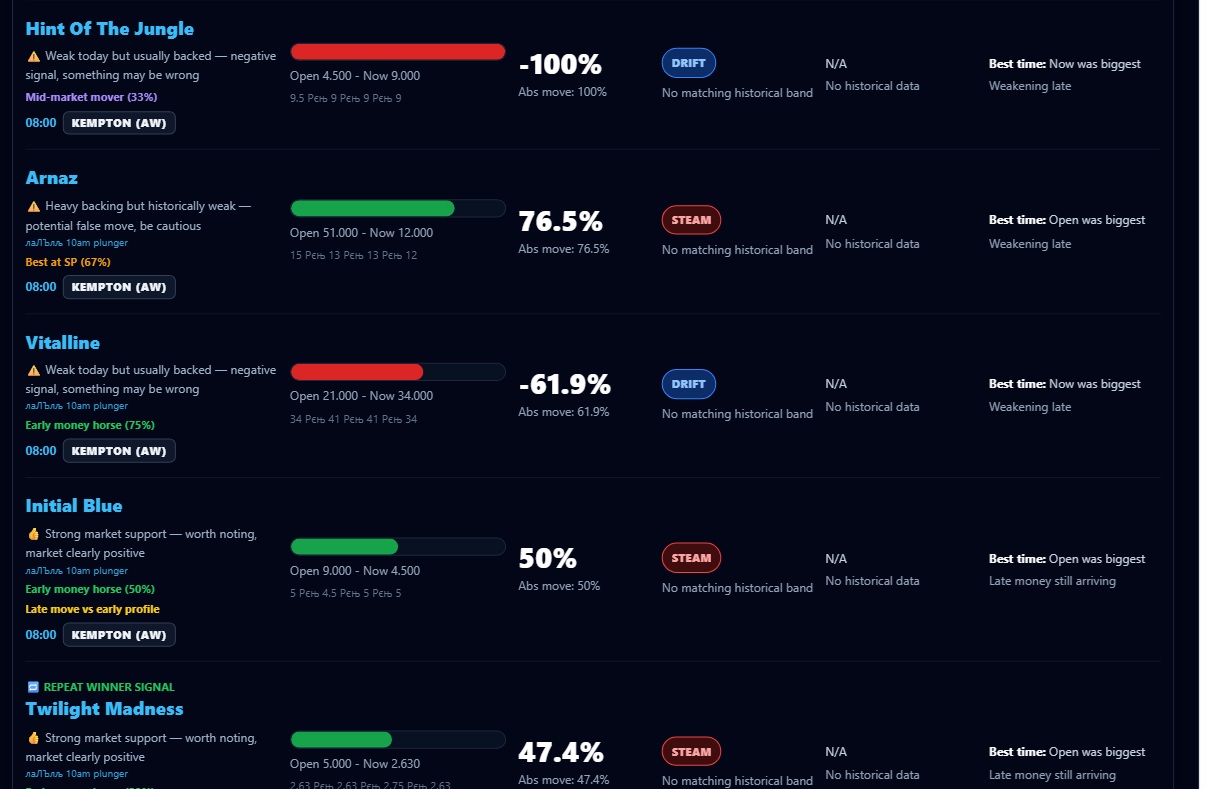
Rather than treating every price change as random noise, Market Form records how horses have behaved within the bookmaker market across previous runs. That history creates an additional form line that can be compared with what is happening today.
What is Market Form?
Market Form is the study of historical bookmaker-market behaviour. It records whether a horse attracted support or drifted during previous runs and asks:
- Does this horse repeatedly attract market support?
- Does that support tend to arrive early or late?
- What happened after similar moves in the past?
- Are there recurring patterns in its price behaviour?
- Does today’s move resemble one seen before a previous win?
Instead of looking only at the finishing position, Market Form preserves the story told by the bookmaker market before the race was run.
Why does it matter?
Most punters use price simply as a point of entry. Market Form also treats price movement as information.
A horse shortening from 8/1 to 5/1 is not automatically a bet. The move could, however, form part of:
- A recurring pattern of historical support
- A move previously associated with a strong performance
- A recognisable early or late market profile
- Sustained pressure across multiple bookmakers
Market Form places the move in context: has something similar happened before, and what followed when it did?
How is it different from traditional form?
Assesses the horse’s performances, conditions, ratings and ability.
Assesses the historical betting-market behaviour surrounding the horse.
Traditional form may show whether a horse is well handicapped. Market Form may show whether today’s support resembles a pattern recorded before one of its better runs. The two approaches are designed to complement each other.
Market Form is not tipster logic
Market Form does not mean blindly following every gamble or automatically opposing every drifter.
It is structured market-behaviour analysis. Support and weakness are measured, compared with historical records and presented as additional evidence—not as certainty.
The core principle
Horses can display recurring market characteristics. Some repeatedly attract support. Some regularly weaken. Others have produced their best performances after a particular type or timing of move.
Market Form records those characteristics so today’s market can be compared with the horse’s own history. Just as conventional form studies the horse’s performances, Market Form studies how the bookmaker market has treated that horse.
How Market Form® is measured
Market Form uses probability points (pp) to measure the significance of price movement. This provides a consistent way to compare moves between horses at very different prices.
Bookmaker prices are recorded at multiple stages of the day, with non-runner adjustments separated from genuine market activity. Current moves can then be compared with more than 100,000 historical betting records.
How DC Network uses Market Form®
Market Form is not one isolated rating. It is the analytical framework behind the platform’s central research tools:
Frequently Asked Questions
Frequently Asked Questions
Clear answers about betting-market behaviour, price movement and how Market Form works.
What is Market Form in horse racing?
Market Form is the study of how horses have behaved in the betting market across previous runs. Rather than focusing on finishing positions alone, Market Form tracks patterns in price movement, showing whether a horse has historically attracted support or drifted before racing.
Is Market Form the same as traditional form?
No. Traditional form looks at race results, ratings and finishing positions. Market Form focuses on the behaviour of the betting market itself, revealing how money and confidence have changed before previous races.
Why do horses drift before races?
Horses can drift in price for many reasons, including lack of support, stronger market confidence behind rivals, fitness concerns, race conditions or simply natural market activity. A drift does not automatically mean a horse cannot win, but it provides additional context.
Why do some horses shorten in price?
When a horse shortens, or “steams”, it means the market is showing increased confidence. This can happen because of stable confidence, favourable conditions, positive information or sustained backing from multiple bookmakers.
Does Market Form predict winners?
No. Market Form does not guarantee results. It is designed to provide context and identify recurring market behaviour, helping users understand how horses have been treated by the betting market over time.
What is a Repeat Winner Signal?
A Repeat Winner Signal is a Market Form pattern where a horse has previously won after displaying a similar market move. When the same type of move occurs again, it creates a repeat pattern that can be monitored.
What is Stable Intent?
Stable Intent refers to situations where multiple runners from the same yard receive significant market support, suggesting the stable may be targeting a meeting or racecard.
Can horses win after drifting?
Yes. Not every drift is negative. Some horses drift and still win comfortably. Market Form aims to provide historical context rather than simple “back” or “avoid” signals.
What is the difference between Market Form and speed figures?
Speed figures measure race performance. Market Form measures betting-market behaviour. They are different tools designed to answer different questions.
What does market support mean in horse racing?
Market support means a horse is being backed and its odds are shortening. Strong support across multiple bookmakers can indicate sustained confidence rather than isolated price changes.
What is a non-trier in horse racing?
A non-trier is a term often used by punters when a horse appears to perform below expectations. In reality, there are many reasons why horses run poorly, including fitness, race conditions and future targets. Market Form seeks to provide context around market behaviour rather than make assumptions about intent.
Can Market Form be used alongside Racing Post form?
Yes. Market Form is intended to complement traditional race analysis rather than replace it. Many users combine Market Form with ratings, speed figures and race conditions to build a fuller picture.
How does DC Network calculate Market Form?
DC Network records and compresses historical bookmaker price movements across multiple stages of the day. These patterns are stored to create a long-term record of how horses have behaved in the market over previous races.